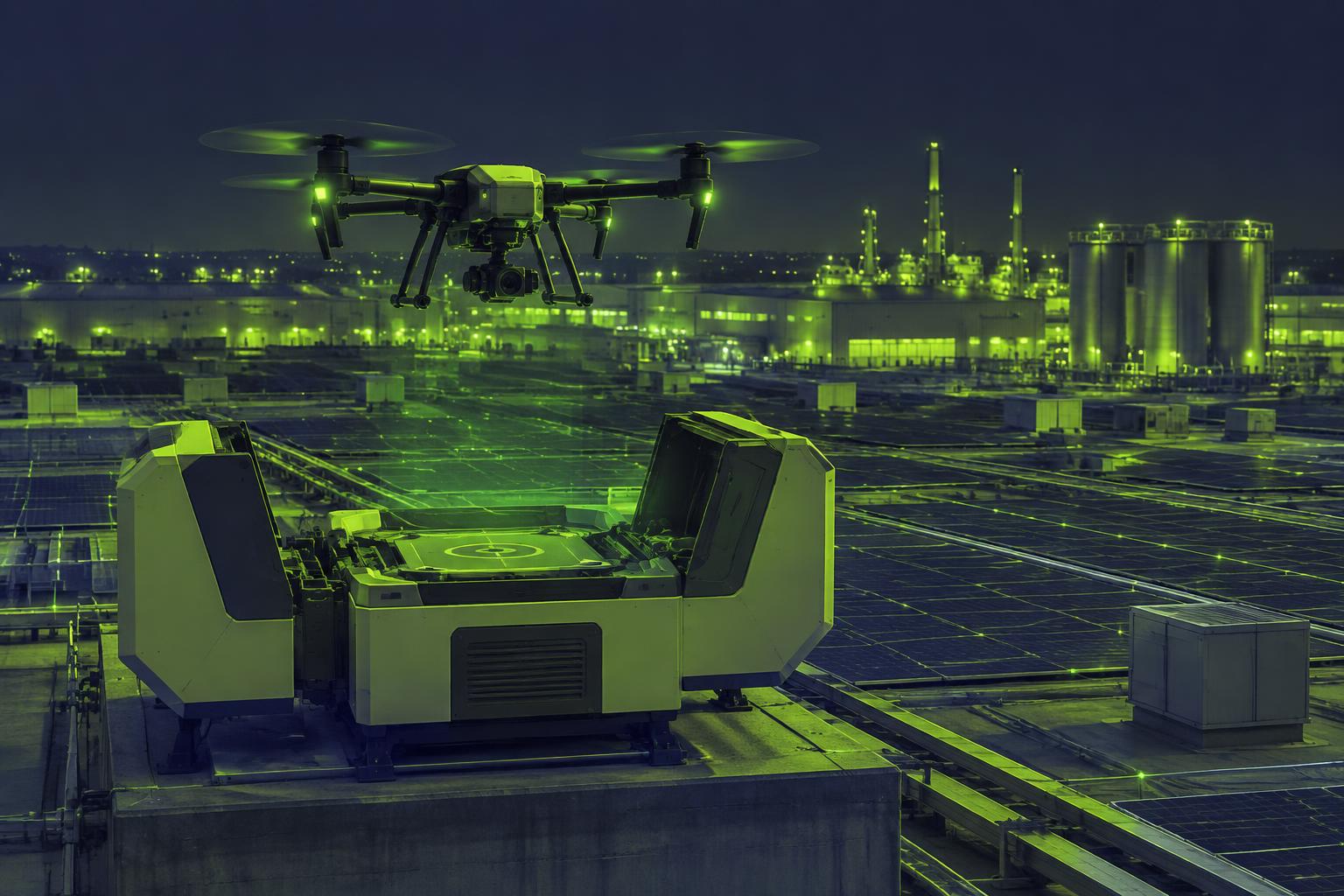
A drone that guards, inspects roofs and prevents failures. The future of security and maintenance has landed
Just a few years ago, drones were associated mainly with aerial photography, filming or military use. Today they are becoming a fully fledged tool for security, building management and predictive maintenance.
By combining autonomous drones, artificial intelligence and a remote monitoring centre, they can monitor large sites, respond to incidents in real time and help detect technical problems before they cause damage. A technology that seemed futuristic until recently is now becoming part of modern integrated facility management.
A self-sufficient unit
The image of a pilot standing in a field with a remote control no longer reflects reality. Modern solutions use docking stations where the drone is permanently based. It takes off on its own, carries out a scheduled mission, lands and automatically prepares for the next flight. The whole process runs without anyone physically on site.
The latest generation of docking stations enables almost continuous operation. After completing a mission, the drone lands automatically, recharges or swaps its battery and is ready for the next operation. This makes it a fully fledged tool for security, monitoring and the management of large sites.
“We are not talking about a drone as a device. We are talking about a new security and operational tool that can extend integrated facility management with a dimension people on the ground simply cannot see,” says Lukáš Převrátil, Director of M2C Space, the remote monitoring centre.
An operator in the monitoring centre, a drone hundreds of kilometres away
The key element of the concept is the connection between the drone and the M2C Space monitoring centre. The drone is not an isolated device. It is part of a wider ecosystem that includes a software platform, camera systems, detection technologies and remote monitoring operators.
The operator can take control of the drone remotely, plan autonomous missions or respond to security events. If, for example, an AI camera or alarm system detects suspicious activity, the drone can take off automatically and provide a live view of the situation within minutes.
“The future of security is not about having more people in the field. It is about the ability to get the right data at the right time and pass it to a person who can respond as quickly as possible and decide what to do next,” explains Lukáš Převrátil.
The drone itself is only one part of the solution. Real value is created only when drone data is connected with video surveillance, the remote monitoring centre, analytical tools and human expertise. A drone can very quickly answer the questions “where” and “what is happening”. Decisions on what to do next, however, are still made by operators, security specialists or response units. This combination of technology and people is one of the main differences between an ordinary drone service and the comprehensive integrated facility management solution M2C offers its clients.
The drone as the facility manager’s new colleague
Most people associate drones mainly with security. In reality, they are also an important tool for facility management.
Thanks to thermal imaging cameras and advanced mapping, a single flight can inspect roofs and leaks, building envelopes, photovoltaic plants, transformer stations and switchgear, HVAC, piping systems and the technical infrastructure of entire sites. The drone also creates a digital model of the building and provides precise data for planning maintenance, renovations or energy measures.
A fault shows up as heat before it becomes a failure
One of the most interesting applications is thermal imaging diagnostics. Every technical defect, whether a leaking roof, a loose terminal in a switchboard or a damaged solar panel, first shows up as a change in temperature. A drone can detect these anomalies before they become a visible problem.
“Technology increasingly allows us to shift the balance between reactive and predictive maintenance in favour of predictive. This is exactly the direction facility management at M2C has been taking in recent years. The more high-quality data we have, the more efficiently we can plan interventions, prevent failures and optimise operating costs,” explains Oldřich Rutar, Strategic Affairs Director at M2C.
During inspections of photovoltaic plants, for example, thermal imaging can reveal so-called hot spots that may pose a safety risk. An entire field of panels can be checked within minutes.
A digital twin of a building within hours
A modern drone is not used for monitoring alone. Using photogrammetry and RTK navigation, it can create an accurate 3D model of a building or an entire site. At M2C we also combine drone data with indoor building scanners, so the result is not just a 3D model of the exterior but a comprehensive digital twin of the whole building.
Such a model makes it possible to record technical assets, plan maintenance, manage investments and create an accurate digital picture of the building including its technical equipment.
From data to savings
What matters most, however, is not the technology itself but the results. Clients receive not just drone images but comprehensive outputs in the form of thermal maps, digital orthophoto maps, equipment records and fault analyses. This makes it possible to pinpoint where intervention is needed and avoid blanket, costly repairs.
In some projects, more than 81,000 m² of production-site roofs were captured in a single day — an area larger than 11 football pitches. In other cases, thermal measurements helped identify specific problem spots on the cladding of industrial halls, so there was no need for a costly replacement of the entire building envelope.
Where will development go next?
Autonomous drones, remote monitoring, artificial intelligence, thermal diagnostics and digital twins of buildings are separate technologies today. The future, however, lies in connecting them into one intelligent ecosystem.
This is precisely the direction of research and development by M2C’s experts. The goal is not to replace people with technology, but to give facility managers, security specialists and building owners tools that make their decisions faster, more accurate and more effective.
And perhaps that is why, in a few years, the greatest benefit of drones will come down to one simple thing: they will solve most problems before anyone even notices them.
YouTube video is disabled
To play this video, enable external media in cookie settings.
“Over the coming years, the digitalisation of buildings will be just as important as their physical management. Without high-quality data, it will not be possible to manage operations, energy or building security effectively.”
Newsletter
Never miss an update
Subscribe and receive expert articles, case studies and technology news straight to your inbox.